Daily Star Banner
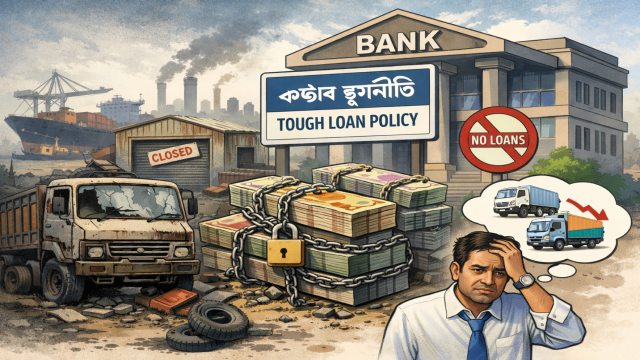
Bangladesh stands at a critical juncture in its economic journey. As the country aspires to graduate smoothly into a middle-income and eventually a developed economy, the role of productive credit cannot be overstated. Among the many sectors that drive employment, logistics, trade, and industrial productivity, the automotive—particularly commercial vehicle—sector occupies a uniquely strategic position. Yet, in recent years, a growing conservatism in retail financing policies by local banks has quietly constrained this sector, resulting in a significant opportunity loss for the national economy.
Commercial vehicles are not luxury items; they are economic enablers. Trucks, pickups, and buses move goods, support SMEs, facilitate construction, connect rural markets, and sustain supply chains. Globally and historically, growth in commercial vehicle penetration closely mirrors growth in GDP, infrastructure development, and trade expansion.
In Bangladesh, the traditional automotive business cycle is well-structured and bank-centric. Vehicles are imported through short-term loans against import documents and duties. Sales occur either in cash or through bank-supported retail finance. For credit sales, vehicles are registered in the name of the financing bank, retail loans are extended to end users, and disbursed funds are used to liquidate the importer’s short-term exposure. This creates a self-liquidating, asset-backed financing loop with identifiable cash flows and tangible collateral.
However, over the last two to three years, most local banks have adopted an increasingly risk-averse stance toward retail financing for commercial vehicles. Even established importers with long track records, strong brands, and historical repayment discipline are facing reduced limits or outright withdrawal of retail finance support. The result is a breakdown of the natural business cycle.
When retail financing stalls, importers are forced to rely disproportionately on cash sales. This ties up working capital, slows inventory rotation, and restricts fresh imports—even when market demand remains strong. Dealers lose momentum, transport operators delay fleet renewal, and logistics costs rise due to aging vehicles. Ultimately, the cost of conservatism is passed on to the broader economy.
From a banking perspective, caution is understandable. The sector has faced stress from macroeconomic volatility, exchange rate pressure, and non-performing loans in certain portfolios. Yet, blanket restriction is not risk management; it is risk avoidance, and risk avoidance comes at a cost.
Retail financing for commercial vehicles is inherently different from unsecured consumer credit. These loans are:
With proper structuring—such as conservative loan-to-value ratios, shorter tenors, insurance coverage, GPS tracking, and joint monitoring with reputable importers—risk can be mitigated rather than eliminated.
Moreover, when banks retreat, informal or inefficient financing fills the gap, increasing systemic risk rather than reducing it.
The opportunity cost of conservative retail finance is substantial. It manifests as:
Bangladesh’s growth ambition requires smart credit, not scarce credit. Banks, regulators, manufacturers, and importers must collaboratively revisit the retail financing framework for commercial vehicles. Credit enhancement mechanisms, comfort structures from global manufacturers, and risk-sharing models can be explored without compromising prudence.
A well-functioning banking system should act as a growth catalyst, not merely a balance-sheet custodian. The automotive sector does not ask for reckless lending—only for measured confidence aligned with economic reality.
If Bangladesh is to sustain momentum in trade, infrastructure, and productivity, conservative retail financing policies in the automotive sector must evolve. Otherwise, the cost of inaction will remain invisible on bank balance sheets—but painfully visible in the nation’s growth trajectory.
Writer: M. A. Aziz
Head of Commercial & Banking
Ifad Autos PLC, Dhaka
Mail: maaziz@ifadgroup.com